Best Axiom Trade Settings: Slippage, Priority Fees and MEV Modes
Table of Contents
- The settings that actually change what you pay
- Slippage tolerance: what each value does
- Priority fee and tip: when raising them is worth it
- MEV protection: the setting most people leave wrong
- Settings for different conditions
- How to verify what a trade actually cost
- What we would need to give you tested numbers
- Related reading
Four settings on Axiom decide what a trade costs you, and three of them persist from your last trade. That combination is why traders lose money on mechanics rather than on judgment: a slippage tolerance sized for a launch that happened an hour ago is still sitting there when you buy something liquid.
Info
What this page is, and is not. This covers what each setting does to execution and cost, with the failure mode at both extremes. The specific ranges are practitioner heuristics and Axiom's own documented defaults, clearly marked as such. They are not the output of a controlled test series, and we do not present them as measured. Nothing here is trading advice, and no part of it is a recommendation to buy anything: it is entirely about the mechanics of how an order executes and what it costs.
There is no universally correct slippage number, and any page giving you one is wrong. Slippage is a ratio between your size and the pool's depth, so the correct value changes per token. What generalizes is the failure mode at each end: too tight burns gas on failed transactions, too loose pre-authorizes a bad fill.
The settings that actually change what you pay
 Four, in descending order of how much they move your cost:
| Setting | What it controls | Default | Persists? |
|---|---|---|---|
| Slippage tolerance | Maximum price movement you accept between submit and fill | User-set | Yes |
| MEV protection mode | Whether your transaction can be sandwiched | Off, Reduced, or Secure | Yes |
| Priority fee | Validator payment for inclusion in the block | 0.001 SOL | Yes |
| Jito tip | Bid into an MEV bundle auction run by Jito | 0.001 SOL | Yes |
Defaults from Axiom's official documentation, read August 2026.
Everything else in the terminal, Quick Buy preset sizes included, changes how much you buy rather than what buying costs. The exception worth flagging: a Quick Buy preset firing an amount you did not intend is the single most expensive mistake available in the interface, and it is a settings problem too.
Slippage tolerance: what each value does
Slippage tolerance is a ceiling, not a target. You are saying: fill this if the price has not moved more than X against me, otherwise abandon it.
The failure mode when it is too tight. The pool moves more than your ceiling between submission and execution, so the transaction reverts. On Solana that still consumes network gas and any priority fee attached, so you pay a small amount for nothing. Ten failures chasing a moving launch is real money and no position. This is the failure people notice, because it announces itself.
The failure mode when it is too loose. The trade fills, at a price much worse than you were shown. Worse, a very high tolerance is an explicit pre-authorization of exactly the price movement a sandwich attacker needs: they buy ahead of you, your order fills into the price they moved, they sell. High slippage does not cause sandwiching, but it widens the profitable window, which is why it pairs badly with MEV protection left off. This is the failure people do not notice, because the trade succeeded.
Practitioner ranges, offered as reasoning rather than as measurement:
- A deep, established token typically fills within roughly 1 to 3%. There is enough liquidity that a normal position does not move the price much.
- A fresh launch on a thin pool often needs 10 to 20% or more to fill at all, because your own order moves the price meaningfully.
Those brackets are wide on purpose. The underlying variable is your size against the pool's depth, and neither number is a property of Axiom. A $200 trade and a $20,000 trade on the same token need different tolerances, which is why copying a figure from anyone, including this page, is weaker than looking at the liquidity column in Pulse before you set it.
Priority fee and tip: when raising them is worth it
Both default to 0.001 SOL per Axiom's documentation, and both buy speed by different routes.  The priority fee pays the validator directly for position within the block.
  The Jito tip bids into an MEV bundle auction run by Jito, a separate company; Axiom's Reduced MEV mode routes through that same third-party infrastructure.
Raising them is worth it when you are in a genuine race: a migration firing, a launch everyone is buying at once, congested blocks. In those conditions the default may simply not land, and a transaction that does not land costs you the fee anyway.
Raising them is wasted when there is no race. On an established token during a quiet market, a higher tip buys you inclusion you were going to get regardless. It is a small waste per trade that compounds across a lot of trades.
The asymmetry worth internalizing: an under-tipped transaction in a race fails and costs you the tip; an over-tipped transaction in a quiet market succeeds and costs you the difference. One of those outcomes is recoverable by retrying and one is simply gone. That argues for erring high in a race and low otherwise, which is the opposite of leaving one value set permanently.
MEV protection: the setting most people leave wrong
Three modes: Off, Reduced (routes through Jito's bundle infrastructure), and Secure (whitelisted validators only, which Axiom describes as slower).
Axiom's own documentation recommends Secure. The reporting that makes that worth taking seriously: Cryptopolitan, October 2025, citing on-chain research credited to 0xGhostLogs, put around 70% of the SOL extracted by wide sandwich attacks over the prior year on users of Axiom. Note what that figure measures: a share of extracted SOL, not a share of victims. The report does not establish a cause. Axiom's share of Solana terminal volume is one plausible factor and protection left off is another, and we cannot tell you how the two divide. Our MEV modes guide carries the full figures and the same caveat.
The honest tradeoff, stated as a tradeoff rather than a recommendation: Secure costs you speed, and speed is the entire point on a migration snipe. Protection you cannot afford on the trades where it matters most is a real limitation, not a solved problem. What is not in tension is everything else: on an established token, or any buy where you are not racing, Secure costs you a slightly slower fill and nothing else.
One detail that halves the decision: a sandwich profits from the price impact of a buy, which is why the setting is aimed at the buy side and why Axiom's documentation frames it that way.
Settings for different conditions
The practical upshot of everything above, as two configurations rather than one.
A quiet market, an established token. Slippage low, in the 1 to 3% region. MEV protection on Secure, since you lose nothing. Priority fee and tip at or near the 0.001 SOL default, because you are not competing.
A launch or migration. Slippage high enough to actually fill, which on a thin pool means well into double digits. Priority fee and tip raised, because the default may not land. MEV mode is the genuine judgment call: Secure is slower and may cost you the fill, Off is fastest and most exposed, Reduced sits between. This is where the pre-authorized-movement problem bites hardest, since high slippage and no protection is the worst combination available.
Warning
The dangerous case is not either configuration. It is the launch configuration left applied to a quiet-market trade: double-digit slippage and MEV off, on a liquid token, because that is how the last trade was set. The trade fills, nothing looks wrong, and you paid for movement you never needed to accept. Check the settings against the token in front of you.
How to verify what a trade actually cost
Do this once properly and the settings stop being abstract.
Open the position in Portfolio and compare the fill against the quote you accepted. Then attribute the difference across the four costs:
- Axiom's platform fee. Axiom's fee docs publish 1% gross, to 0.75% net at the top cashback tier. Predictable, and worth re-checking there because rates change.
- The AMM's own fee. Set and published by the AMM, not by Axiom, and not quoted in Axiom's interface. Pump.fun's Dynamic Fees schedule for PumpSwap is tiered by market cap, running from roughly 1.25% at the smallest tier down to about 0.30% at the largest as published on Pump.fun's own fee docs, read August 2026. Check there rather than here, since it is their schedule to change.
- Network gas plus any tip. Small, and paid even on failure.
- Realized slippage. The remainder, and on a thin pool usually the largest item.
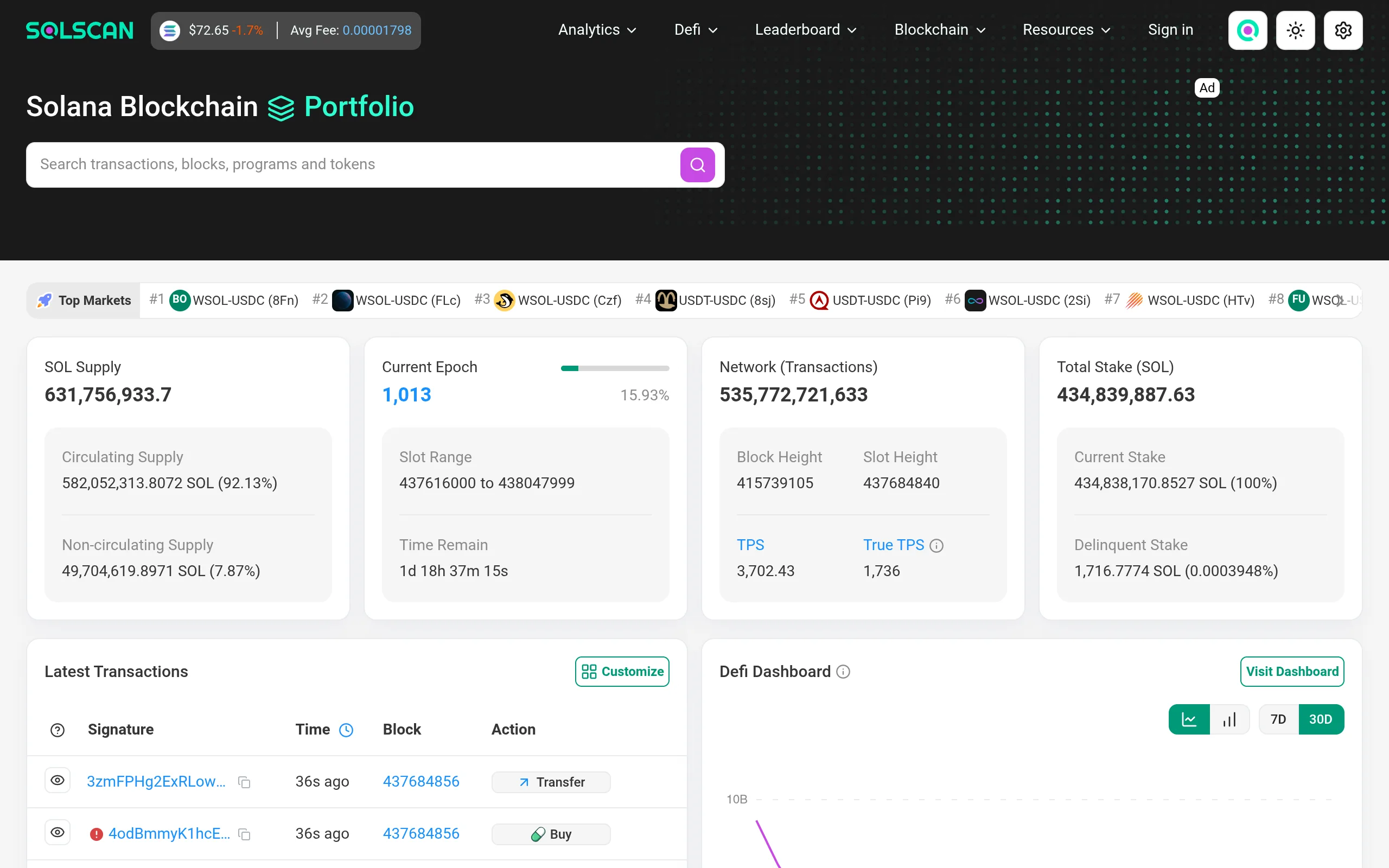
Source: Solscan, used under fair use for educational purposes
 If the fill looks wrong or a transaction seems stuck, look it up on Solscan before concluding the platform is broken. It tells you whether the transaction landed, failed, or never broadcast, which separates a settings problem from a congestion event from an actual fault. When it is a fault, common Axiom problems and fixes covers the ones with known causes.
For the full cost stack across terminals, the Solana terminal fee index breaks a $500 swap into all four components, and Axiom fees explained covers Axiom's own layer including the cashback ladder.
What we would need to give you tested numbers
Stated plainly because this page's honesty is worth more than a confident-sounding table.
Turning the ranges above into tested values means running identical swaps at varying slippage tolerances and tip levels on the same token within the same window, recording fill quality and failure rate at each setting, and repeating it across pool depths. That requires real capital at risk across many executions, and until it is done, anyone publishing "the optimal Axiom slippage setting" as a single number is reasoning from the same mechanics described here and presenting it as measurement.
What generalizes without testing is the reasoning: the failure modes at each extreme, the asymmetry between an under-tipped race and an over-tipped quiet trade, and the fact that settings persist. That is enough to stop losing money on mechanics, which is the actual goal.
Trade on Axiom
Sign up through our link for an automatic 10% discount on the platform fee, applied from your first trade.
Trade on AxiomRelated reading
The terminal walkthrough shows where each of these settings sits in the order ticket. Pulse explained covers the liquidity and holder-concentration filters that tell you what pool depth you are dealing with before you set a tolerance. If a filter name on that screen is doing work you cannot follow, every Pulse column and filter is defined individually, and which filters to set for a given objective groups them into six presets.
Frequently Asked Questions
It depends entirely on the pool's depth relative to your position size, so there is no single correct number. The figures that follow are practitioner heuristics rather than measured results, and we have not tested them: a deep established token typically fills within roughly 1 to 3 percent, while a fresh launch on a thin pool often needs 10 to 20 percent or more to fill at all. Size the tolerance to the pool in front of you. If a transaction fails repeatedly at the same setting, the tolerance is too tight for what you are buying.
You authorize the trade to fill at a much worse price than quoted, and on a thin pool it will. Very high tolerance also widens the window a sandwich attack can profit from, because you have pre-approved the price movement an attacker needs. The trade succeeds and costs you more than it should, which is why an unusually high tolerance is not a safe default.
The transaction fails. On Solana a failed transaction still consumes network gas and any priority fee you attached, so it costs a small amount and produces no position. Repeated failures on the same token are the clearest signal your tolerance does not match the pool's depth.
Both default to 0.001 SOL per Axiom's documentation, and both buy faster inclusion through different mechanisms. A priority fee pays the Solana validator directly to prioritize your transaction within the block. A Jito tip bids into an MEV bundle auction run by Jito, a separate company. Axiom's Reduced MEV protection mode also routes through Jito's infrastructure, so the two touch the same third-party system. They are not interchangeable and raising one does not substitute for the other.
Axiom's own documentation recommends Secure. Cryptopolitan reported in October 2025, citing on-chain research from 0xGhostLogs, that around 70 percent of the SOL extracted by wide sandwich attacks over the prior year came from users on Axiom; that reporting does not establish a cause, and Axiom's share of Solana terminal volume is as plausible a factor as protection left off. Secure routes through whitelisted validators and Axiom describes it as slower, so the honest tradeoff is that it may cost you fills on genuine races and protects you everywhere else. A sandwich profits from the price impact of a buy, so the setting is aimed at buys.
Yes. Slippage, MEV mode, priority fee and Quick Buy presets all carry over from your last trade, so a tolerance set for a fresh launch stays applied when you next buy something liquid. That persistence is the mechanism behind a common and avoidable mistake. Check the settings against the token in front of you rather than against the one you traded an hour ago.
Open the position in Portfolio and compare the fill against the quote you accepted, then break the difference into the four costs: Axiom's platform fee, the AMM's own fee, network gas plus any tip, and realized slippage. If the fill looks wrong, look the transaction up on Solscan, which will tell you whether it landed, failed, or never broadcast.
Axiompedia is an independent educational resource. It is not affiliated with, produced by, reviewed by, endorsed by, or sponsored by Axiom Innovations Inc., the operator of axiom.trade, or any of its affiliates. "Axiom" and the Axiom logo are trademarks of Axiom Innovations Inc., used here only to identify the product this site writes about. Full disclaimer.
Disclaimer: Nothing on this site is legal, tax, financial or investment advice. Trading carries risk, including total loss. Whether any activity described here is permitted where you live, and how it is taxed, depends on your jurisdiction and your circumstances. Consult a qualified professional and the primary sources before acting. Past performance does not indicate future results. Always check the primary source and do your own research before trading. This site contains referral links, which are disclosed on the disclosure page.
Ready to Start Trading?
Sign up on Axiom through our link for a 10% discount on trading fees, applied automatically with referral code axiompe.
Save 10% on Fees